
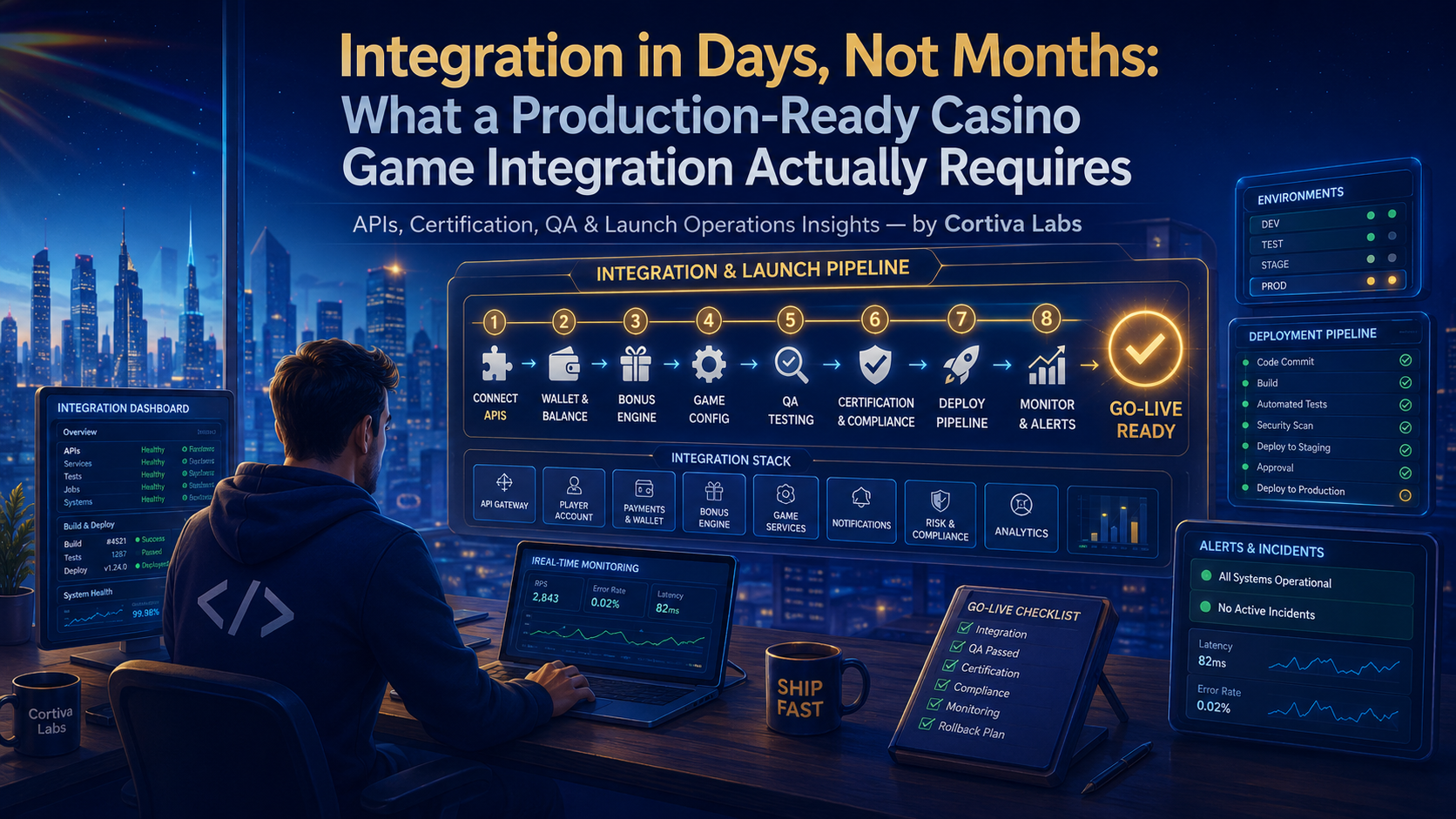
A game may open successfully in a sandbox, accept a test bet, return a win, and appear ready for launch. But that proves only that the simplest transaction path works under controlled conditions. A production-ready integration must also survive duplicate requests, network interruptions, delayed provider responses, partial failures, maintenance windows, configuration changes, incorrect currencies, restricted jurisdictions, and disputes involving real balances.
The difference between a demo and a production integration is not the launch button. It is everything that happens when the ideal sequence breaks.
The Game Launch Is Only the Front Door
The visible launch begins with authentication. The operator typically sends a request containing the player, game, language, currency, device, jurisdiction, and return URL. The provider or aggregator responds with a secure game session.
Behind that apparently simple exchange are several questions. How long is the session valid? Can it be reused? What happens after the player logs out? Can a suspended or self-excluded account still launch an existing session? Is the game permitted in the player’s location? Does the chosen version support the account currency? Is demo mode clearly separated from real-money mode?
A production integration must validate these conditions before the game begins, not after a prohibited or technically invalid transaction has been created.
Remote systems are expected to implement published rules correctly, process and settle gambles according to those rules, monitor live performance, and take prompt corrective action when faults affect customers.
The Wallet Is a Ledger, Not a Balance Field
The most sensitive part of an integration is the movement of value.
In a seamless-wallet model, the provider does not permanently hold the player’s balance. It calls the operator or aggregator whenever it needs to place a bet, credit a win, cancel a transaction, or retrieve the available balance. That creates a distributed financial process involving systems that may respond at different speeds and fail independently.
A reliable wallet integration should treat every operation as a uniquely identifiable event. The same bet request may be sent twice because the provider did not receive the first response. A win may arrive after a temporary timeout. A rollback may reference an earlier transaction. Two requests relating to one round may be processed concurrently.
Without idempotency, the system risks deducting the same bet twice or crediting the same win more than once. Without immutable transaction records, the operator may be unable to reconstruct what happened. Without reconciliation, small inconsistencies can accumulate into financial and regulatory exposure.
GLI-19 states that systems should confirm or deny every automated financial transaction, maintain adequate audit trails, and provide transaction histories using unique transaction identifiers. The standard also addresses manual balance adjustments, refunds, game histories, and daily reconciliation with payment providers.
Technical principle: A timeout is not a result. It means that the caller does not know the result. The integration must verify transaction status before deciding whether to repeat, reverse, or complete the operation.
“Speed should come from standardization, not from skipping controls,” says Stefanos Skourides, Fonder of Cortiva Labs. “A provider can be connected quickly when wallet behavior, game-round states, certification data, and failure handling follow a proven integration framework. Launching fast without those controls simply moves the work from development into incident management.”
Every Game Round Needs a Recoverable State
Casino games do not all follow the same transaction sequence. A basic slot may create one bet and one settlement. A bonus feature may generate several related events. Blackjack and other stateful games can involve multiple decisions. Live casino products depend on table states, video infrastructure, dealer actions, and external event timing.
The platform therefore needs a clear game-round model. At a minimum, it should know whether the round is created, active, settled, canceled, rolled back, or awaiting investigation. Every financial event must be linked to the correct round and player.
Interrupted gambling rules provide a practical benchmark. For example UK standards say that when an outcome has already been determined and the player can no longer influence it, the result should normally stand. Where no outcome has been generated, a deducted stake may need to be returned. For stateful games, reasonable steps should be taken to restore the last known state.
This requires more than retrying an HTTP request. It requires durable round states, replay-safe transactions, and enough information to determine whether a game can continue or must be settled administratively.
Certification and Configuration Must Travel With the Game
A game name is not a sufficient technical identifier.
The same title may exist in several builds with different RTP settings, mathematical models, languages, jackpots, or market approvals. A provider update may affect only certain configurations. Certification may apply to a specific version, while a later version is still awaiting approval in one jurisdiction.
A production-ready integration should therefore treat certification and configuration as part of the deployment record. The operator should be able to identify the exact game version, provider identifier, RTP profile, jurisdiction status, and effective dates associated with a launch.
Randomness is another area where technical delivery and compliance intersect. Across regulated markets, game outcomes are generally expected to be generated by tested and independently verifiable random number systems, without adaptive mechanisms that alter probabilities during play. Game rules, payout logic, probabilities, and displayed results must also be presented clearly, consistently, and fairly.
The aggregator does not replace the testing laboratory or game studio. It does, however, need to ensure that the correct certified content is delivered to the correct market.
Jurisdiction Logic Cannot Be Added at the End
Many integration problems begin when market restrictions are treated as a lobby issue rather than a transaction-level control.
Removing a game tile from search results is not enough if an old bookmark, cached launch link, or direct API request can still open it. Jurisdiction restrictions must be enforced at the launch layer and, where necessary, at the wallet or session layer.
The same principle applies to currencies, age requirements, account status, responsible-gaming restrictions, and permitted product features. A game may be technically functional but still inappropriate for a market because of autoplay, game-cycle speed, simultaneous-play functionality, bonus mechanics, or display requirements.
Responsible product design illustrates how detailed jurisdictional differences can become. Across regulated markets, rules may address features that encourage chasing losses, the simultaneous use of multiple games, session controls, and mechanics that affect the speed or intensity of play. Because these requirements continue to evolve, market-specific rules should be maintained as dynamic configuration rather than treated as fixed launch documentation.
Observability Is Part of the Product
When a player reports that a bet was deducted but the game froze, support teams need an answer quickly. “We have contacted the provider” is not an adequate observability strategy.
A production platform should connect the player session, game round, bet, win, rollback, provider request, response code, and internal ledger entry through shared identifiers. Technical teams should be able to search one reference and reconstruct the complete sequence.
Monitoring should also detect patterns before they become large-scale incidents. A rising launch-failure rate for one provider, increased wallet latency, unusual rollback volume, or a cluster of incomplete rounds can indicate a problem before customer complaints arrive.
Business continuity is equally important. GLI-19 calls for disaster-recovery planning that addresses the storage and recovery of sensitive and gaming data, the circumstances in which recovery procedures are invoked, and the technical steps required to restore operations.
Testing the Failure Paths
Successful integration testing should go beyond checking the standard bet-and-win sequence. Teams need to simulate duplicated callbacks, expired sessions, invalid signatures, unsupported currencies, provider timeouts, late wins, repeated rollbacks, negative-balance attempts, maintenance mode, and a loss of communication during a stateful round.
The objective is not to prove that failures never happen. It is to prove that failures remain controlled, traceable, and financially correct.
A staged rollout is often more valuable than a dramatic full-catalog launch. Starting with selected games, limited traffic, or one jurisdiction allows teams to compare logs, reconciliation results, latency, and support cases before expanding exposure.
What “Days, Not Months” Should Mean
Fast integration should not mean compressing months of unresolved risk into a few days of development. It should mean that the integration partner has already created reusable technical contracts, certification workflows, test cases, monitoring, and provider-specific adapters.
Cortiva Labs publicly describes its model around providing certified casino content to licensed operators without the complexity of numerous direct integrations. That proposition depends on more than API access. It depends on turning accumulated integration knowledge into repeatable infrastructure.
A production-ready connection is one in which the normal flow is fast and the abnormal flow is predictable. Bets remain reconcilable. Rounds remain recoverable. Restrictions remain enforceable. Incidents remain diagnosable.
That is the real meaning of integration in days rather than months.